


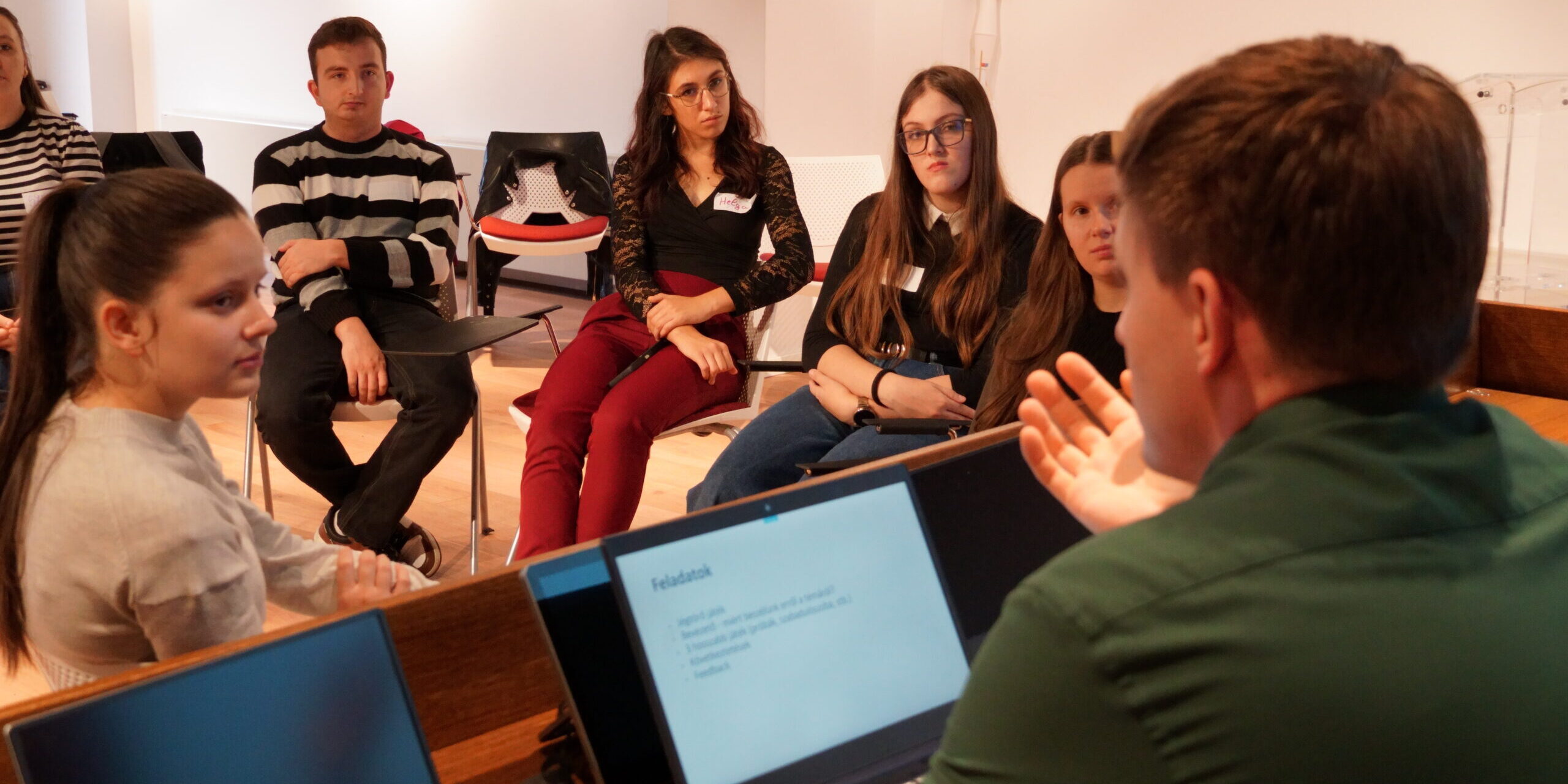
On October 23–24, 2026, we held our health education and prevention training at Studium Hub, preparing high school and university students to share health-related knowledge with their peers.
Over the two days, participants explored lifestyle, sexual education and the basics of resuscitation with the guidance of professionals. They also had the opportunity to try out methods and techniques needed to lead educational sessions. After all, knowing a topic well is not enough: it is equally important to know how to talk about it in a way that truly engages young people, encourages their participation and gives them space to ask questions.
Learning from One Another and from Professionals
Friday afternoon began with an introduction to the programme and some icebreaker activities. This was followed by a methodological session led by Erzsébet Zalányi, during which the participants explored group facilitation and ways to maintain young people’s attention.
The professional training then continued across three thematic areas.
In the lifestyle group, participants discussed questions related to healthy living under the guidance of Dr. Mónika Szabó, Dr. Márta Germán-Salló and Dr. László Marton. Sexual education was covered under the guidance of Dr. Hunor Kraft, with particular attention to how sensitive issues affecting young people can be addressed openly, credibly and in an accessible way.
During the BLS (Basic Life Support) training, delivered with the contribution of PONTIS (Dr. Róbert Berei, Dr. Hunor Réti, Dr. Zsolt Tamás and Dr. Bernadett Nagy), participants acquired essential knowledge of basic life support. These practical skills can make the difference between life and death in an unexpected emergency.
Putting Learning into Practice
Saturday began with team-building activities, followed by practical sessions in all three thematic areas. Participants had the opportunity to deepen their knowledge and explore how they could pass on what they had learned to school students.
Continuing Our Work Together
The aim of the training is to enable participants to join the Szent Balázs Foundation’s school-based prevention programme in the future, delivering sessions on healthy lifestyles, sexual education, basic life support and first aid.
We believe that important health-related questions deserve to be discussed openly and clearly from an early age. Alongside professional expertise, peer influence and shared experiences also play an important role in helping young people understand and engage with these topics.
We would like to thank all the trainers and professional contributors for sharing their knowledge and experience, and the participants for their active involvement and enthusiasm. We hope to put what we have learned together into practice during school sessions soon and bring reliable health information to even more young people.